
In accounting, winning a new client is only the start of the journey. The real test begins when you onboard them. It’s in the first weeks of a client-firm relationship that expectations are set, trust is built, and the groundwork for long-term retention is laid.
Yet, for many accounting firms, onboarding is an operational sinkhole. It consumes more time than expected, involves repetitive admin, and too often leads to delays or errors.
In fact, according to KPMG, 87% of accounting and finance leaders report that improving client onboarding is a strategic priority [1].
This is exactly the kind of problem we set out to solve with Samera AI. But before we get to the solution, it’s worth understanding the real, often hidden, costs of traditional onboarding.
The Problem with Traditional Client Onboarding
Most firms know onboarding is important, but few realize just how much inefficiency is baked into the process.
1. Manual Processes That Waste Hours
From collecting ID documents and engagement letters to setting up accounting software and gathering historical financial data, traditional onboarding relies heavily on human input.
According to a survey by Dext, 56% of accountants and bookkeepers say they spend too much time on manual tasks, even while only 26–50% of tasks are currently automated [2].
This gap has real consequences:
- Resource Drain: Hours lost to data entry or reconciliation are hours not spent on strategic client work, analysis, or business development.
- Scaling Friction: As client volume increases, manual processes multiply friction. Without automation, firms must choose between hiring more staff or accepting slower throughput.
- Human Error: More manual work means more mistakes, from miskeyed data to missed follow-ups, triggering time-consuming fixes or compliance risks.
- Stalled Transformation: The report also notes that accountants expect automation to rise to 51–75% of tasks in the next decade, highlighting widespread awareness that current processes aren’t sustainable.
For an accounting firm, treating manual onboarding as an operational necessity ignores a hidden but growing cost. It quietly undermines both client satisfaction and firm growth.
2. Higher Risk of Errors and Omissions
Every manual step in onboarding is a chance for something to go wrong. Missing documents, data entry mistakes, or delayed follow-ups can derail the process.
For example:
- Incorrectly keyed bank details may delay payroll setups.
- A missed compliance form can push back the first filing deadline.
- Incomplete historical data can affect the accuracy of initial reports.
These issues not only cause extra rework but also make the firm look disorganized in front of new clients, not the first impression anyone wants.
3. Onboarding Bottlenecks Limit Scalability
Most firms don’t feel the pain when they’re onboarding one or two clients a month. But when growth accelerates, say, after a marketing push or acquisition, the cracks show quickly.
Karbon’s The Definitive Guide to Client Onboarding reveals client onboarding for accounting firms commonly takes from 3-4 hours in basic cases at least 6–8 weeks in complex ones [3]
Teams already busy with existing workloads can’t absorb the extra onboarding tasks without sacrificing either quality or timelines. This is why, for many firms, onboarding becomes the choke point that limits how many new clients they can realistically take on each month.
4. Delays Damage Client Experience
In accounting, the onboarding stage sets the tone for the entire client relationship. If the process drags on because documents are missing, data entry is slow, or approvals take too long, clients start questioning whether the firm can deliver on its promises.
New clients expect a smooth handover and quick integration into your systems. When they encounter repeated follow-ups, multiple requests for the same documents, or long gaps in communication, their confidence drops.
This also affects referrals. A client who experiences clunky onboarding is far less likely to recommend your firm, regardless of how good your work is later.
The longer the onboarding takes, the later your firm can start generating billable work from that client. This lost time not only hits revenue but also creates opportunity costs, as staff remain tied up with administrative back-and-forth instead of taking on new, higher-value work.
How Samera AI Fixes Onboarding for Accounting Firms
When we built Samera AI, client onboarding was one of the first areas we targeted. Not because it’s the most glamorous part of running an accounting firm, but because it’s where operational pain is felt most sharply.
Here’s how we’ve re-engineered onboarding using AI, without losing the personal touch that clients value.
1. Eliminating Bottlenecks in Data Collection
The problem:
For most firms, the first hurdle in onboarding is collecting the right documents, bank statements, prior year tax returns, ID proofs, incorporation papers, and payroll records. In reality, clients delay sending these, or they send them piecemeal over weeks. This creates an immediate bottleneck and can drag onboarding into months.
How Samera AI helps:
- Automated request lists: Generates a personalized checklist for each client based on their profile and service package.
- Smart reminders: Sends follow-up reminders at optimal times so accountants don’t have to chase.
- Centralized document vault: Clients upload everything into one secure portal, with AI verifying completeness in real-time.
2. Reducing Errors from Manual Data Entry
The problem:
Once documents arrive, junior staff often spend hours manually keying data into multiple systems, practice management software, tax tools, and bookkeeping platforms. This not only eats up time but also leads to errors, especially with large transaction histories. Every error can snowball into compliance issues or rework costs.
According to Gartner, 58% of finance teams were using AI in 2024, including intelligent process automation and anomaly detection, up 21 points from the prior year [4].
How Samera AI helps:
- Direct integrations: Pulls client data straight from bank feeds, Companies House, and existing accounting platforms.
- Error flagging: AI cross-verifies figures against supporting documents and flags discrepancies before they reach your senior staff.
- One-click sync: Once verified, the data flows automatically into all linked tools, no retyping needed.
3. Preventing Delays in Service Kick-off
The problem:
Even after documents are in, delays often occur in assigning work internally. Managers wait for complete files, partners hold off on reviewing, and clients are left wondering if anything is happening. This erodes trust early on.
How Samera AI helps:
- Parallel processing: AI assigns portions of work as soon as relevant documents arrive, so different teams can start without waiting for the full set.
- Progress tracking: Clients can see exactly what’s been received and what’s pending, cutting down on “what’s happening?” emails.
- Automated internal alerts: Notifies responsible staff the moment a client hits onboarding milestones so work begins instantly.
4. Maintaining a Personal Touch at Scale
The problem:
When firms grow, personal touches, like a welcome call, personalized advice, or timely follow-ups, often vanish. Clients start to feel like just another file number. This is dangerous because first impressions during onboarding set the tone for retention.
On the upside, 22% of firms confirm AI has already improved task automation and overall business operations, signaling faster onboarding and more personal client interactions [5].
How Samera AI helps:
- Personalized communication: Uses client data to tailor welcome messages, progress updates, and milestone acknowledgements without requiring extra admin time.
- Advisor alerts: AI notifies account managers of high-value or at-risk clients so they can step in with a personal call when it matters most.
- Post-onboarding care: Schedules an automatic check-in 30 or 60 days after onboarding to ensure clients are happy and using services fully.
5. Freeing Senior Staff from Low-Value Work
The problem:
Partners and senior managers often get pulled into fixing small onboarding errors or chasing documents, tasks that waste their expertise and billable potential. Over time, this slows down the firm’s growth because leadership is stuck firefighting.
How Samera AI helps:
- Escalation filters: AI resolves routine document issues automatically and only escalates truly complex cases.
- Standardized workflows: Creates consistent onboarding processes so juniors handle more without constant supervision.
- Dashboard oversight: Leaders can monitor all onboarding progress from one view without being dragged into day-to-day admin.
6. Making Client Understanding Instant and Transferable
The problem:
During onboarding, managers and accountants often spend days just understanding a new client’s books, i.e., their chart of accounts, recurring transactions, outstanding balances, and filing history. In fact, a study by Harvard Business Review reveals employees spend nearly 4 hours per week reorienting themselves after switching between applications [6].
When that knowledge sits with one person, any change in staffing causes major disruption. This inefficiency slows onboarding, delays delivery, and increases the risk of missing key financial patterns.
How Samera AI helps:
- Automated client profiling: The system instantly analyses uploaded data, mapping the client’s bookkeeping structure, key transaction categories, and recurring patterns.
- One-glance dashboards: Within minutes, accounting managers can understand a client’s full financial layout, meaning no need to dig through prior files.
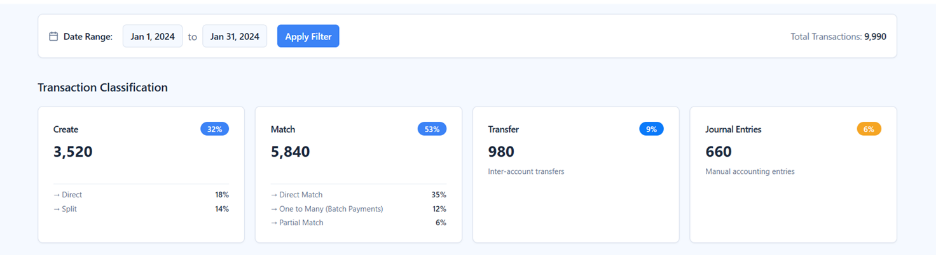
- Seamless file continuity: If a new accountant takes over, all prior insights, tags, and context remain intact. There’s no dependency on knowledge transfer as intelligence sits within the system, not the individual.
Final Word
For most accounting firms, onboarding isn’t seen as a “profit lever”. Instead, it’s treated as an administrative chore. That’s a costly oversight.
If your onboarding is slow, repetitive, or error-prone, you’re not just burning hours, you’re signaling inefficiency to the very people who hired you for financial clarity. In an industry where margins are tight and client expectations are rising, you can’t afford to let the first impression slip.
The firms that win in the next five years will be those that see onboarding not as a bottleneck, but as a competitive advantage.
Samera AI is being built to give you that edge, a system that makes onboarding seamless, accurate, and scalable without losing the personal touch your clients expect.
If you want to see where accounting technology is truly headed, and what it looks like when onboarding becomes a growth engine instead of a drag, don’t wait for your competitors to figure it out first.
We’re building Samera AI to set the benchmark for how firms onboard, manage, and delight clients in the digital era. This is your chance to get in early, watch it evolve, and prepare your firm for the next wave of AI-powered efficiency.
👉 See the future of client onboarding with Samera AI:
Bibliography
- https://kpmg.com/xx/en/media/press-releases/2024/11/ai-adoption-across-finance-functions-achieves-standout-levels-of-roi.html
- https://www.accountex.co.uk/insight/2023/05/17/mundane-and-manual-dext-survey-reveals-nearly-60-of-accountants-spend-too-much-time-on-manual-tasks
- https://assets.ctfassets.net/2wd1w7hp7waa/3iNm7OuDbSMWsHkMfu4xjd/c0830fe9e4145224786e99a91f02dd37/The_Definitive_Guide_to_Client_Onboarding_by_Karbon.pdf
- https://www.gartner.com/en/newsroom/press-releases/2024-09-11-gartner-survey-shows-58-percent-of-finance-functions-use-ai-in-2024
- https://www.globalbankingandfinance.com/the-battle-of-robots-and-accountants-with-a-side-of-statistics
- https://hbr.org/2022/08/how-much-time-and-energy-do-we-waste-toggling-between-applications